Sunday, December 16, 2018

Data Analysis Checklist

I've spent the evening and early morning hours reading The Elements of Data Analytic Style - A guide for people who want to analyze data by Jeff Leek (This book is for sale at http://leanpub.com/datastyle), and wanted to post this amazing data analysis checklist here so that I may continually refer back to it. 

The data analysis Checklist -- A way to evaluate the quality of a reported data analysis.

14.1 Answering the question
1. Did you specify the type of data analytic question (e.g.
exploration, association causality) before touching the
data?
2. Did you define the metric for success before beginning?
3. Did you understand the context for the question and
the scientific or business application?
4. Did you record the experimental design?
5. Did you consider whether the question could be answered with the available data?

Saturday, December 15, 2018

Half a Year Later...

Wow, I can't believe it's been nearly half a year since I worked on my computer science studies. I've spent the last three months or so developing wood burning skills, which I have greatly enjoyed. I've also been missing my time in the ether. I'm going to attempt to divide my extracurricular endeavors between crafting and coding.

Monday, August 6, 2018

I'm learning R, in R

I've recently discovered an amazing package for R called Swirl. I realize it's been around for some time now, but it's new to me, and I love it. Swirl() is a straight-forward, user-friendly approach to diving right into R. Each lesson is delivered interactively and in short bursts. The lessons are succinct and detailed, and leave the user feeling informed. For anyone looking to get started with R, I strong recommend Swirl().

library(swirl)
swirl()


Sunday, July 29, 2018

R Programming by Johns Hopkins University

I am about to begin R Programming from Johns-Hopkins by way of Coursera! This is course 2 of 10 that I am working through on my way to becoming a Data Scientist.

In this course, I will learn how to program in R and how to use R for effective data analysis. I will learn how to install and configure software necessary for a statistical programming environment and describe generic programming language concepts as they are implemented in a high-level statistical language. The course covers practical issues in statistical computing which includes programming in R, reading data into R, accessing R packages, writing R functions, debugging, profiling R code, and organizing and commenting R code. Topics in statistical data analysis will provide working examples.


Sunflow Data Science & Analytics

My name is Austin Craver and I am a budding Data Scientist. 

I just launched www.SunflowData.com to act as a repository for my progress and work.

It is called Sunflow Data.

Discovering new ways to take raw data and turn it into meaningful results. We strive to continually ensure that the analysis is relevant, and we are committed to providing clean, in-depth datasets.


Sunday, July 15, 2018

Data Science Specialization = My New Focus

I am focusing entirely on Data Science for the next year. I really liked studying HTML5, CSS, JavaScript, jQuery, SQL, C, and more, but alas I must focus. I must focus on one thing and learn to do it well. That thing is Data Science.

I recently received a scholarship that covered the $50.00 required to take The Data Scientist's Toolbox from Coursera via Johns Hopkins, for which I am truly grateful. However, it was just an intro to the comprehensive specialization and I finished what was presented as a four-week course in two sittings. I am trying to accept that it will all be a joyful uphill journey from here and just have fun with the process as a whole. Never before have I so thoroughly enjoyed the learning process.

The following excerpt is from a free lesson via DataCamp:


Wednesday, July 4, 2018

At a minimum, a data scientist should...

I wish I could remember where I copied and pasted this from, but alas, I cannot. Just the same, here's a great overview of what a data scientist would benefit from understanding.

At a minimum, a data scientist needs to be proficient with concepts such as probability, correlation, variables, distributions, regression, null hypothesis significance tests, confidence intervals, t-test, ANOVA, and chi-square. At an advanced stage, data scientists need concepts and algorithms such as logistic regression, support vector machines (SVMs) and Bayesian methods. Common statistical analysis tools such as Excel, R and SAS are very famous among data scientists.


Friday, June 29, 2018

Telling Stories With Data

I'm moving through some great data science material via Cognitive Class (Big Data University) via a course titled (appropriately) Introduction to Data Science. One of the modules discussed one of the many areas in which a great data scientist must possess strength, storytelling.


1. Tell readers, at the outset, what they might gain by reading your paper.
2. Make the aim of the work clear. 
3. Explain the significance of your contribution.
4. Have you set your work in the appropriate context by giving sufficient background (including a complete set of relevant references) to your work?
5. Have you addressed the question of practicality and usefulness?
6. Have you identified future developments that might result from your work?
7. Have you structured your paper in a clear and logical fashion?

Original version of the cited text...

Sunday, June 24, 2018

Harvard University...

I just completed three full days of on-site continuing education at Harvard University. (The $1,200 fee was waived by the Computer Science department.) We engaged in 22 hours of in-person instruction and I completed 15 hours (closer to a hundred?) of preparatory work.


Sunday, June 17, 2018

2D, 360 Degree, Virtual Reality...

A long-time friend of mine is in a local band called THE HORRiFiCS and I am pleased to be doing a blended photo shoot with them in 11 hours. I've been focusing my photographic efforts almost entirely on local businesses for several months, so it's a nice change of pace. I'm taking my portable photo studio for more traditional shots, then we're going on-location, and along the way, I'll be capturing some 360° photos and possibly videos!!!


Friday, June 15, 2018

My Tableau Public Profile

I am super excited (and tired (it's 3:09 AM)) to be diving further into the boundless world of Data Science. One of my best friends was in town a few days ago and he introduced me to Tableau. A couple of days later, I had a fully licensed copy installed on my machine. Two days after that, I got to attend a roundtable discussion at Gleneagles Country Club in Plano, Texas. I was surrounded by a small group of community leaders in Data Science. The cities of Plano and Dallas had representatives there, as well as a variety of Data Scientists from a broad range of companies. It was a great experience, and I can't wait to attend other such events.

Austin Craver - Data Analytics

I have spent the last several hours pouring over datasets and doing my best to produce something meaningful, all while telling a story.


I have since created two original data visualizations. One shows male and female life expectancies around the world. The other shows Internet usage by country.

Tuesday, June 12, 2018

Tableau/Prep

As I continue my journey, things continue to fall into place. For example, I was just granted a one-year research and education license of both Tableau and Tableau Prep!!! I cannot wait to grab a dataset and dive into the next chapter of my data science life.

I just download, installed, and registered Tableau and Tableau Prep! 

Saturday, June 9, 2018

Tensors Flowing

In approximately 12 hours, one of my best friends will be arriving from Houston and we plan on spending the day coding. I am starting Chingu's Voyage 6 and look forward to gleaning as much as I can from his boundless programming expertise. In the meantime, since he mentioned TensorFlow, I have read up on it, which lead me to study tensors in general. The more I learn about machine learning and data science, the more confident I am that I will be learning much more.


Friday, June 1, 2018

Python Programming

I'm studying intermediate programming in Python and the DataCamp course I'm taking is using Google Sheets. All of the following information was copied and pasted entirely for me to easily locate in the future. ---

DATEDIF

Calculates the number of days, months, or years between two dates.

Sample Usage

DATEDIF(DATE(1969, 7, 16), DATE(1969, 7, 24), "D")
DATEDIF(A1, A2, "YM")
DATEDIF("7/16/1969", "7/24/1969", "Y")

Syntax

JavaScript Variables

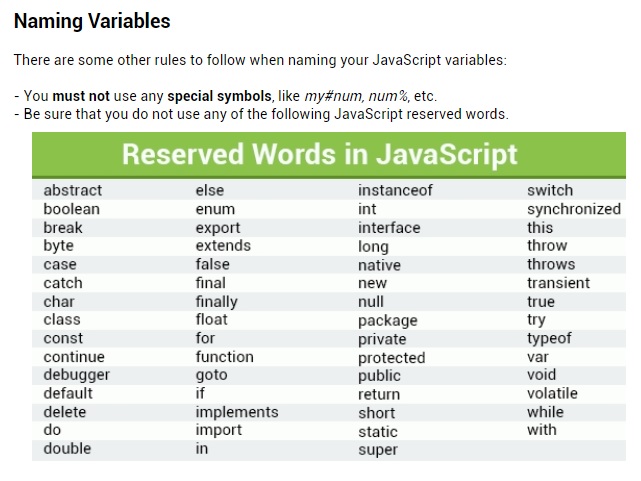
Going to spend some time this weekend studying JavaScript. The image below was extracted from a screenshot of a course I'm taking via SoloLearn.

According to the website:

Naming Variables


There are some other rules to follow when naming your JavaScript variables:

- You must not use any special symbols, like my#num, num%, etc.
- Be sure that you do not use any of the following JavaScript reserved words.


Join the learning adventure: Learn JavaScript


Sunday, May 27, 2018

Your Code Are Dumb

I was reading a great article from Hacker Noon (link at the bottom of the page) and there was a paragraph about a variety of acronyms and phrases related to software engineering. For the sake of remembering them, I'm going to use Google to track down their respective meanings and copy and paste them below.

According to Wikipedia, YAGNI, or, you aren't gonna need it is a principle of extreme programming (XP) that states a programmer should not add functionality until deemed necessary.  XP co-founder Ron Jeffries has written: "Always implement things when you actually need them, never when you just foresee that you need them." Other forms of the phrase include "You aren't going to need it" and "You ain't gonna need it".

Again, from Wikipedia, the single responsibility principle is a computer programming principle that states that every module or class should have responsibility over a single part of the functionality provided by the software, and that responsibility should be entirely encapsulated by the class.

DRY simply stands for Don't Repeat Yourself. Whereas WET is short for We Enjoy Typing.  Both of which suggest that well thought out code should be succinct and avoid unnecessary repetition.

The Single Level of Abstraction (SLA) or the Single Level of Abstraction Principle (SLAP) states that "each method should be written in terms of a single level of abstraction."


Thursday, May 24, 2018

Immutable Tuples

Python + SoloLearn = Awesome! I'm currently learning about lists, dictionaries, and tuples. I can't wait until June when I'll be able to focus full time on computer science.


Saturday, May 19, 2018

White Hat Kali Linux

I just completed a brief introductory course via StackSkills covering various aspects of ethical white hat hacking. The course covered such things as;

basic terminologies, operating systems and tools, reconnaissance, NMap, Shodan for scanning, Metasploitable, Armitage, Aircrack-ng, Man-in-the-middle-attacks (MitM), and more.

Friday, May 18, 2018

SQl + SoloLearn = Amazing

I've spent the last several hours studying Structured Query Language (SQL) and I am really enjoying the straightforward syntax and ease of use that it offers. Having studied PHP previously is also helping.


Course = JAVA // Complete!

I've just recently finished an introductory course in JAVA. I'm currently studying PHP and plan to finish that course this weekend.


Saturday, May 12, 2018

Monadic and Dyadic Operators

Monadic and Dyadic Operators
Operators can be monadic or dyadic A monadic operator operates on a single simple statement. Other operators will all be dyadic operators because they operate on two simple statements. Any time you use an operator with a simple statement, even a monadic operator, you create a compound statement.

Compound Statements and Truth Function
All the compound statements we'll look at are called "truth-functional" compound statements. This means that the truth value of the entire statement is determined by the truth value of the individual simple statements that make it up and the function of the operator on those statements.

If you write computer programs, you can think of the simple statements as inputs and the operator as the function that accepts those inputs and does something with them. The output of the entire function is determined by the value of the inputs and the specific operation of the function. Consider this simple program written in pseudocode which will take a string value and change the value to all caps and then print it to the screen:
Function PrintCaps (string A)
{
    A = AllCaps(A);
    Print A
}

Sunday, May 6, 2018

React and Team Tree House

I just invested several hours of time and ample mistake correction and produced an interactive scoreboard program using React.  Team Tree House is a stunning online education platform that offers a rich and diverse array of course offerings that span a wide range of topics related to computer programming. I seriously wish there was more time for learning!


The *.jsx code =

var PLAYERS = [
  {
    name: "Player 1",
    score: 0,
    id: 1,
  },
 
  {
    name: "Player 2",
    score: 0,
    id: 2,
  },
 

SQL

I've hit a wall in my SQL studies via the Khan Academy, and as such, I am engaging in additional studies prior to attempting to move for...